Electric Guitar Lessons
Learn electric guitar through the sound and songs that made you pick it up—while building the muting, timing, articulation and fretboard understanding that make those parts feel convincing.
Find Your Best Next Step ↗Enquire free · Pay once your lesson time is confirmed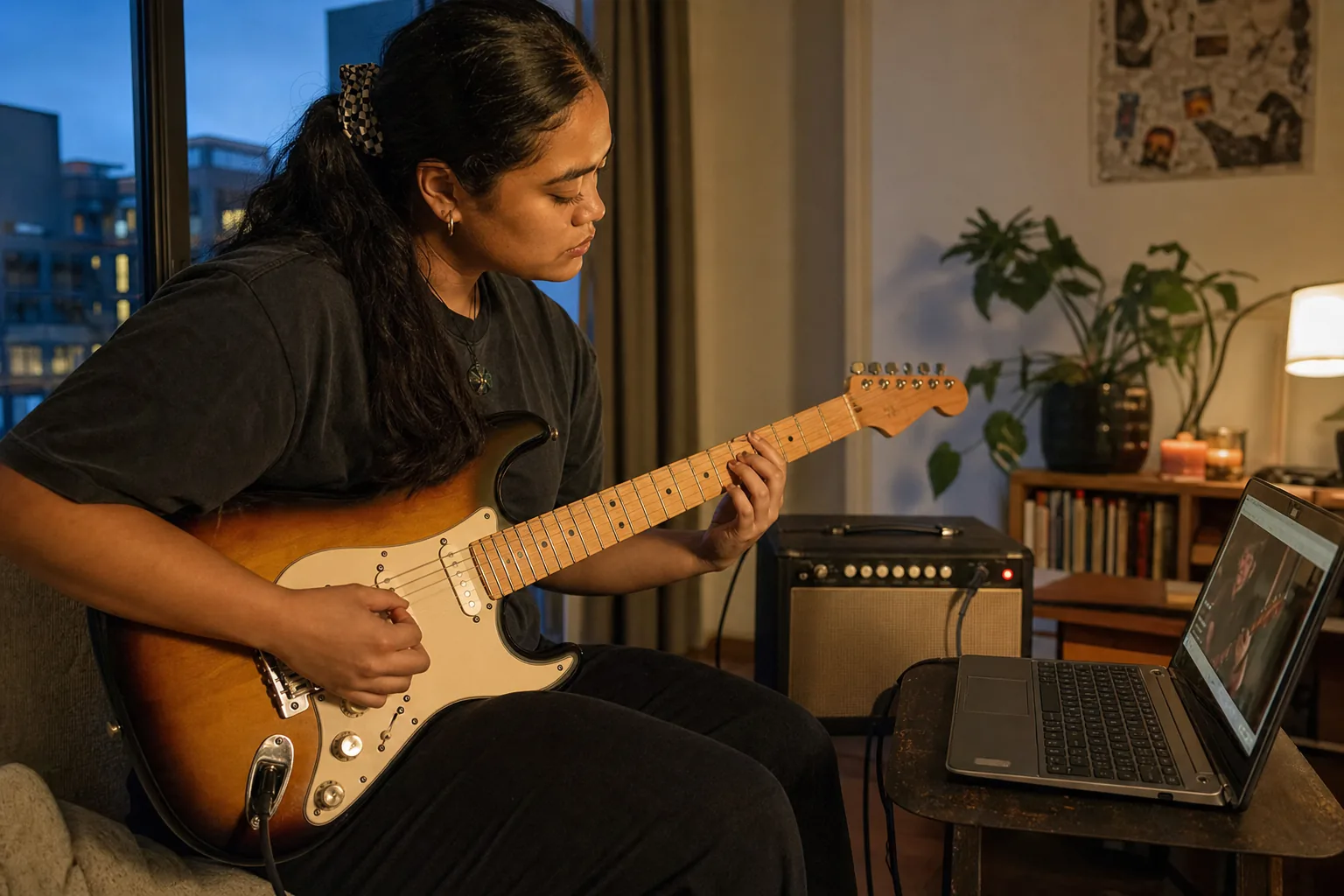
Why this feels difficult
Electric guitar can hide and magnify problems at the same time. Gain adds excitement, but unused strings ring, bends miss pitch and riffs lose impact when the fretting and picking hands are not coordinated.
Good muting is an active part of tone, not merely the absence of noise.
A riff needs pulse and articulation before it needs more speed.
Lead playing becomes musical when bends, vibrato and phrasing serve a phrase.
Scales become useful when connected to chord tones and the ear.
A sensible learning path
- 1Set a clean baseline for fretting, picking and muting.
- 2Build a complete rhythm part at a stable tempo.
- 3Develop bends, vibrato and short lead phrases.
- 4Connect scale shapes across a real progression.
Where a live teacher changes things
Your teacher can hear whether the issue is timing, pick attack, string noise, note choice or gear—and keep a technique problem from being misdiagnosed as a tone problem.
You learn directly with your teacher. Your teacher does not change from week to week, so each lesson can build on what happened last time.
Questions students ask
Do I need an amplifier for an online lesson?+
Not necessarily. A small amp at a sensible volume is useful, but an unplugged electric guitar can still be used for technique and movement work.
Can lessons cover rhythm and lead guitar?+
Yes. Lessons can combine riffs, rhythm, muting, bends, vibrato, phrasing and fretboard knowledge around the music you want to play.
Will lessons help with unwanted string noise?+
Yes. Muting, pick attack and coordination can be observed and adjusted in real time.